How Does the PDK Get into the Taycan – and Why?
The innovative E-Shift function simulates the mechanical gear changes of an eight-speed dual-clutch transmission. Drivers can actively shape the Taycan’s immense power delivery much as they would in an internal combustion Porsche, experiencing it through sight, sound, and feel.

Your eyes lock onto the hairpin rushing toward you. A quick pull on the left paddle of the GT steering wheel drops the car into second gear. The tachometer needle sweeps toward the redline as a sharp jolt ripples through the chassis, accompanied by a guttural growl. The drivetrain’s engine braking blends seamlessly with the friction brakes, scrubbing off speed with pinpoint precision. Then, at the apex, it’s back on the accelerator – full throttle. Torque arrives instantly and relentlessly. Another quick tug on the right paddle. A decisive jolt courses through the car before the surge resumes. Third gear engaged. It’s one of those unmistakable Porsche moments when everything comes together.
And yet, until recently, a scene like this couldn’t have existed. The car coming round the circuit is an all-electric Taycan, shifting through eight virtual gears. It’s made possible by the new E-Shift option, which expands the emotional driving experience across the entire Taycan lineup. E-Shift faithfully recreates the sensation of Porsche’s eight-speed dual-clutch transmission, the PDK, delivering an astonishingly authentic experience for all the senses.
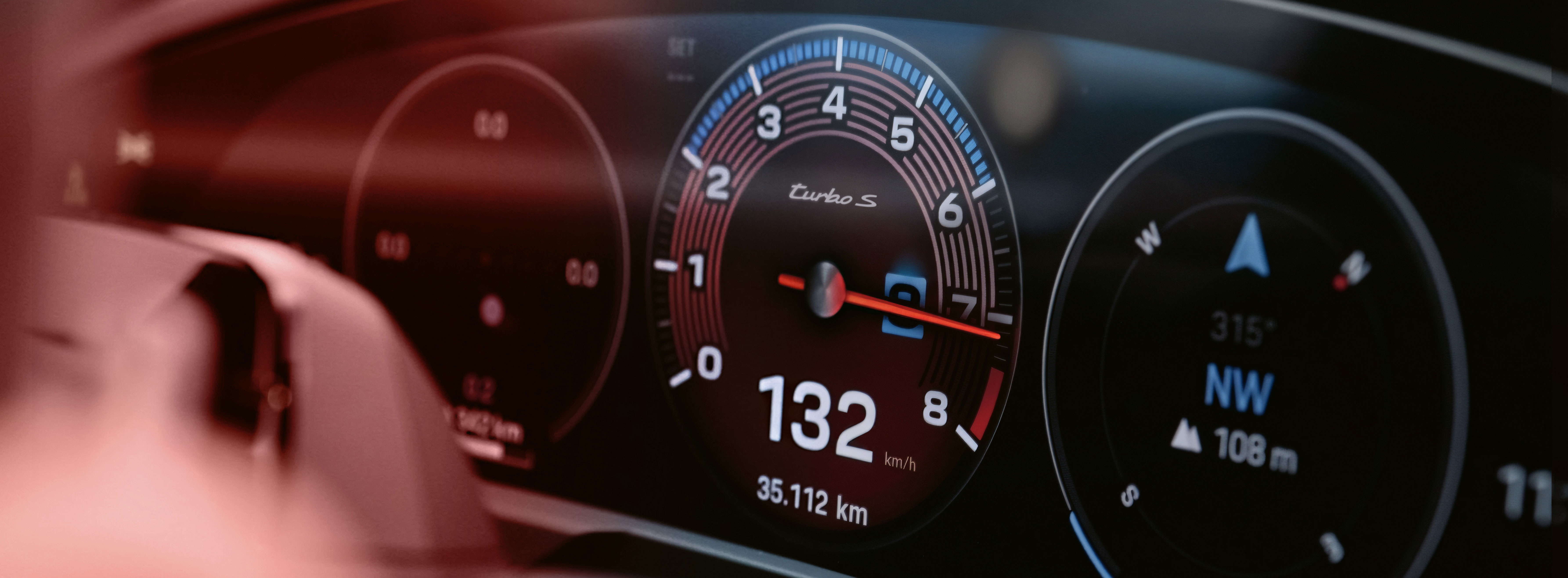
It’s a remarkable software-driven innovation, one that resonates deeply with Taycan drivers. After all, they’ve already experienced something akin to a gearshift. From the very beginning, Porsche engineers in Stuttgart-Zuffenhausen paired the rear electric motor with a two-speed transmission, combining explosive launches with exceptional high-speed performance. In Sport Plus mode, drivers can already feel a subtle jolt as the transmission shifts between gears – much like an internal combustion sports car. The new E-Shift system, available as an option across all Taycan derivatives for the 2027 model year, amplifies that sensation dramatically. An evocative sound, a centrally positioned tachometer that climbs up to 7,500 rpm, a rev limiter, steering wheel-mounted shift paddles, and the tangible kick accompanying each virtual up- and downshift all combine to create an immersive driving experience.
At first, the concept seems contradictory. For decades, Porsche engineers have devoted themselves to making gear changes ever faster, more precise, and increasingly imperceptible. Consider the evolution from the Tiptronic transmission introduced with the third-generation 911 (964) to today’s PDK, whose shifts are executed with virtually no interruption in power delivery. And now, of all places, it’s in an electric sports car, where interruptions in torque have largely been engineered out of existence, that Porsche has deliberately made shifting something drivers can once again experience. To accomplish this, the development team ventured deep into the software. In simplified terms, they programmed seven additional gear changes. Why?
“E-shift brings a new dimension to the driving experience,” explains Markus Lindermeier, the Porsche engineer responsible for E-Shift. He’s not talking about familiar performance figures such as kilowatts, acceleration, or downforce, but about emotion. Because at the Porsche Development Centre in Weissach, the engineers know that one thing is true: Drivers who shift for themselves feel more connected to the car. Anyone who enjoys dynamic driving instinctively understands this. They don’t rely solely on speed, but on the interplay of forces, sound, and tactile feedback. In a combustion-engine Porsche, engine speed plays the starring role. In the Taycan equipped with E-Shift, the Porsche Electric Sport Sound now responds to the electric motor’s rpm and provides compelling acoustic feedback.

Push the button; ignite the emotion:
The steering wheel-mounted control brings the E-Shift function to life.
“Colleagues turned around to look at the car and wanted to know what I’d done to it.” Maximilian Geiger
The goal of the E-Shift isn’t to make the Taycan faster. Instead, the simulated transmission is designed to draw the driver into a closer relationship with the car, delivering an immediate and intuitive experience. It’s much like driving today’s 911 Turbo models: In Manual mode, the driver keeps the engine in an ideal rev range, chooses the perfect moment to shift, and actively shapes the way the car delivers the power. In the alternatively selectable Automatic mode, E-Shift behaves much like the familiar PDK found in Porsche’s combustion-engine and hybrid models. “E-Shift brings more emotion and more feedback into the car,” Lindermeier says, summing up the philosophy behind the innovation.
To create a simulation convincing enough to feel completely authentic, Porsche’s engineers programmed the precise behavior of a real PDK into the vehicle’s electronic control systems. “We’re talking about many PDK functions,” says Lindermeier, explaining the concept using downshifts under braking. “Depending on how hard I’m braking, the system shifts into lower gears. In corners, it holds the gear to maximize stability. And in Automatic mode, it recognizes the driver’s style and adapts its shift strategy accordingly.” Try to accelerate in too high of a gear, and the Taycan responds sluggishly, just as a combustion-engine car would.
And just as in a combustion-engine sports car, the right sound is an essential part of the experience. A jolt needs an “acoustic feedback,” Lindermeier says with conviction. “Without it, it simply doesn’t work. We’ve tested it. It feels unnatural,” he says. That’s where the sound designer Maximilian Geiger comes in. Together with his team, he faced a formidable challenge. “We had to design a complete drivetrain sound across the entire rev range, from idle all the way to the limiter.” The sound varies continuously according to the virtual engine speed as well as the vehicle’s actual load and road speed. While it builds on the existing Porsche Electric Sport Sound, the new acoustic experience is considerably more sophisticated.

Some of the parameters that naturally emerge from the mechanics of a combustion engine had to be created entirely in software for the Taycan. To achieve this, the team took measurements of the engine and vehicle to develop the highly evocative sound, a key element of the driving experience. Geiger knew they were on the right track the first time he drove a prototype around Porsche’s test site. “Colleagues turned around to look at the car and wanted to know what I’d done to it,” he recalls. That reaction confirmed they had found the right direction, but the work was far from finished. The team went on to develop several distinct sounds, each with their own emphasis. “If you listen carefully, you’ll be able to distinguish individual Taycan models simply by the way they sound,” says Geiger.
Drivers are in for a new auditory experience when they start the car. After all, an electric car producing an idle sound seems almost contradictory by comparison. Even while stationary, the animated tachometer needle gently quivers. The sound adapts dynamically to this. while an electrified growl overlays the deep underlying tone depending on the load. At around 4,000 rpm, the familiar character of the Porsche Electric Sport Sound becomes unmistakable. On the move, the system provides subtle acoustic cues about speed and load, helping the driver to judge the car’s behavior with remarkable precision.
The experience is also enriched by a new physical dimension. The simulated gearshifts create distinct breaks in the electric powertrain’s continuous acceleration and structure the power delivery. Depending on the selected driving mode, the effect becomes even more pronounced. A shift light and rev limiter provide both visual and tactile cues, clearly marking the ideal shift window. Drivers can take complete control using the steering wheel-mounted paddles or simply allow the Automatic mode to handle the gear changes.

Manual gearbox:
The new E-Shift function lets drivers use the steering wheel paddles to simulate gear changes.The central interface between driver and software, between human and virtual transmission, is the new GT Sport steering wheel. It’s the central mechanical element inside the cockpit. A new mode switch, positioned exactly where drivers of the 911 GT3 RS can adjust the traction control, brings E-Shift to life. A press of the button activates the virtual transmission. Turn the rotary selector, and the system switches between Manual and Automatic modes.
The two shift paddles behind the steering wheel serve more than one purpose. Pull both paddles simultaneously, and Push-to-Pass is unleashed, delivering a brief burst of additional power for rapid overtaking maneuvers or sprints while simultaneously selecting the ideal gear for maximum traction: “It’s a control concept we can use on the racetrack at any time,” explains Lisanne Schaal from the Concept Development team. “In this situation, the driver keeps both hands on the wheel. That’s an important safety advantage.” When E-Shift is switched off, the shift paddles take on another function altogether; they allow the driver to adjust regenerative braking through three settings: “Off,” “Level 1,” and “Level 2.” “That gives the driver the opportunity to fine-tune lift-off regeneration both in everyday driving and on the racetrack,” Schaal says.
This brings us back to virtual transmission and to the obvious question: Does E-Shift make the Taycan slower? “During a gearshift, we briefly reduce the available torque, but immediately restore it afterward,” explains Markus Lindermeier. “Overall, the net effect is zero. The car is every bit as fast as before.” In the process, the engineers achieved something genuinely innovative. The virtual first and second gears both operate within the maximum power band of the transmission’s real first gear. Only at lower power levels or in higher virtual gears does the rear axle’s more efficient physical second gear come into play.
The E-Shift package can be configured for every Taycan model and every body style, and is available now. With the 760 kW (1,034 PS; Taycan Turbo GT (WLTP)*: Electrical consumption combined: 21.2 – 20.5 kWh/100 km; CO₂ emissions combined: 0 g/km; CO₂ class: A) Taycan Turbo GT, it comes as standard.