Why Is the Transaxle Concept Still So Fascinating Today?
A successful sports car is defined by dynamism and balance. The transaxle design set new benchmarks.
Principles like work-life balance, equilibrium, and stress management dominate the lives of many people today. Porsche engineers were already thinking about the optimal balance more than 50 years ago, at a time when a new drive architecture for sports cars was under development at the Weissach Development Centre – the transaxle design with the engine up front and the transmission at the back. The concept delivered near-perfect weight distribution to both axles. The 924 was launched with this drive configuration in 1976, which was followed by the 928 as a powerful gran turismo in 1977. This marked the dawn of the transaxle era, which continued with the launch of the 944 in 1981 and reached its zenith with the 968 introduced in 1991. This technology is still considered to be revolutionary, trailblazing, and innovative to this day.
Magic wand:
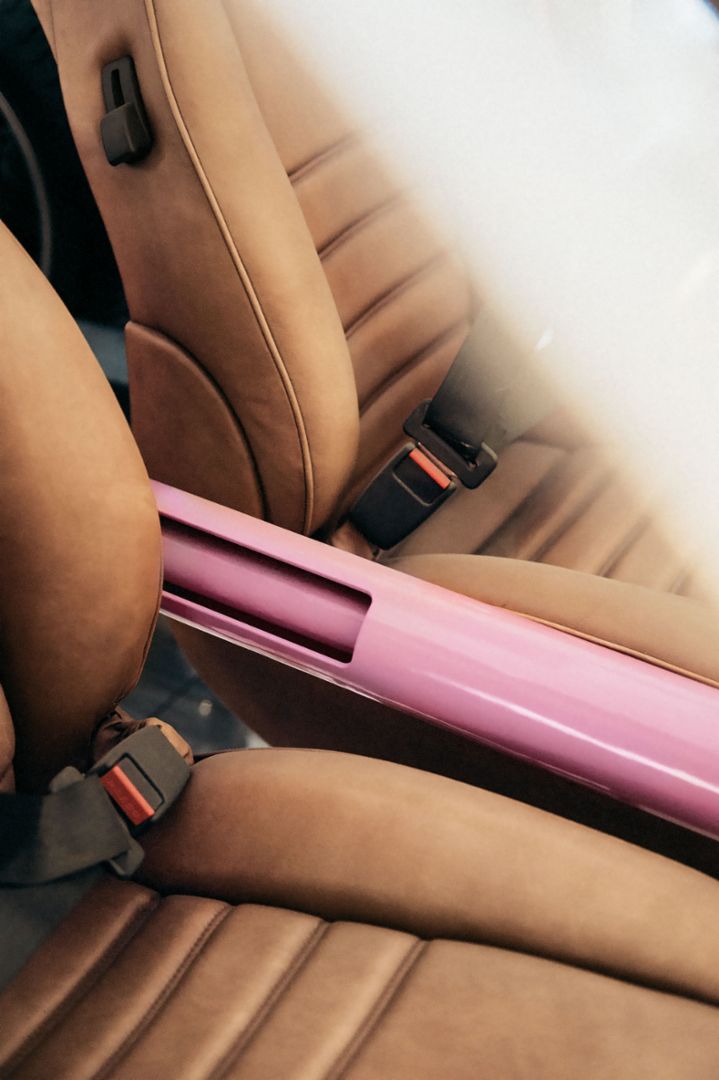
The driveshaft in the transaxle tube that transfers power from the engine to the rear axle.The term “transaxle” is a combination of the two words “trans” (Latin for “beyond,” “across”) and “axle,” and refers to the transmission of power. The clutch transmits the torque of the water-cooled engine, which is positioned above the front axle, to a driveshaft – the actual transaxle – and from there to the transmission and differential at the rear axle. The shaft measures 20 to 25 millimeters in diameter and around 1.50 meters in length and, supported by multiple ball bearings, rotates inside a rigid central tube, which extends from the front to the rear axle, passing between the two front seats.
“Transmission at the back, engine up front – transaxle between them” was the message in full-page ads designed to explain the new transaxle concept in a catchy way. A novelty at Porsche. The company never restricted itself to one type of design. To date, there have been mid-engine concepts such as the 914 and of course the 911 principle with air-cooled rear engine and rear-wheel drive. The 356 that started it all was also a rear-wheel drive. Vehicles of this design tend to have quirks and can sometimes respond unpredictably. They represent sporty driving and require driving skill, strength, courage, and quick responses.
There were many both inside and outside the company who were skeptical of the new drive philosophy, which was designed for balance and control. This uncertainty also surfaced at the premiere of the 924 in the south of France. According to the press release, “The latest Porsche delivers half the power of the most potent model, but 80 percent of the speed, and is just as sporty.” What may come across as quite defensive was entirely appropriate for emphasizing the new strengths of the car, as the whole point of reconfiguring the drive layout was perfect balance. And that’s precisely what the company achieved by positioning the two heavyweights – the engine and the transmission – at the front and back, resulting in near-perfectly balanced axle load distribution. In that respect, the 924 was a “true driver’s car,” as the advertising back then promised. That’s something it had in common with the 911, even if the characters of the two sports cars were completely different.
Technology platform:
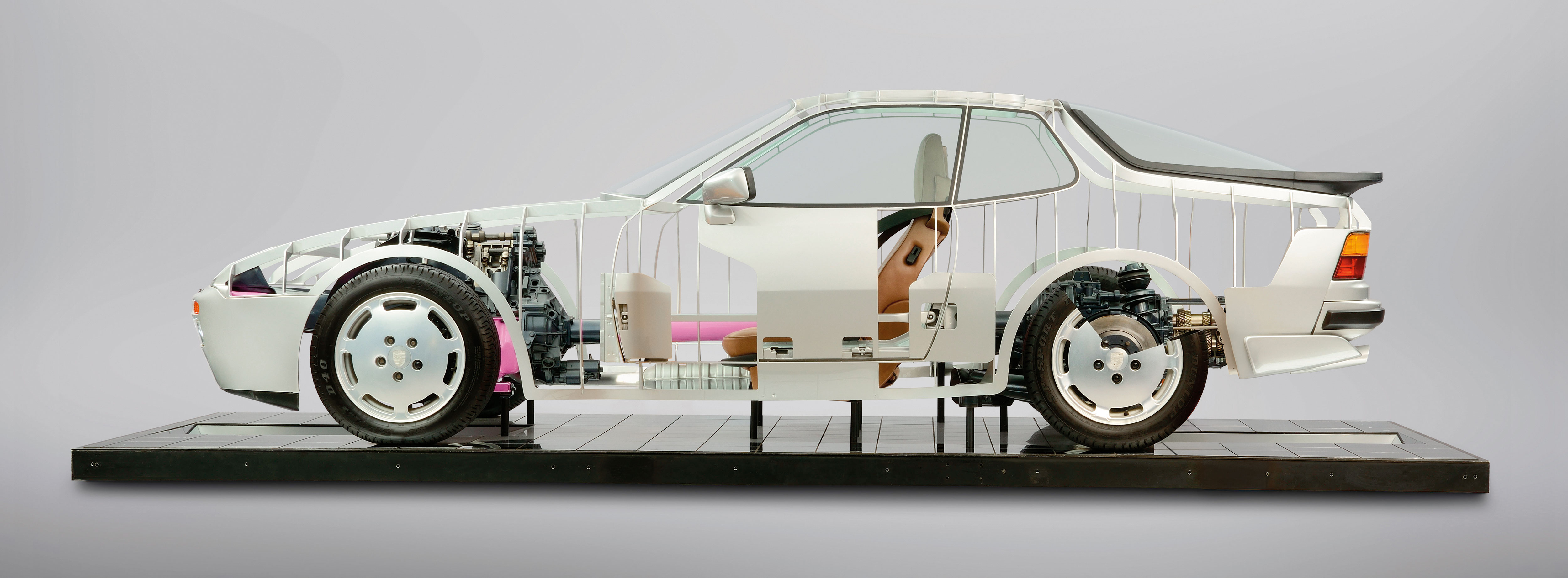
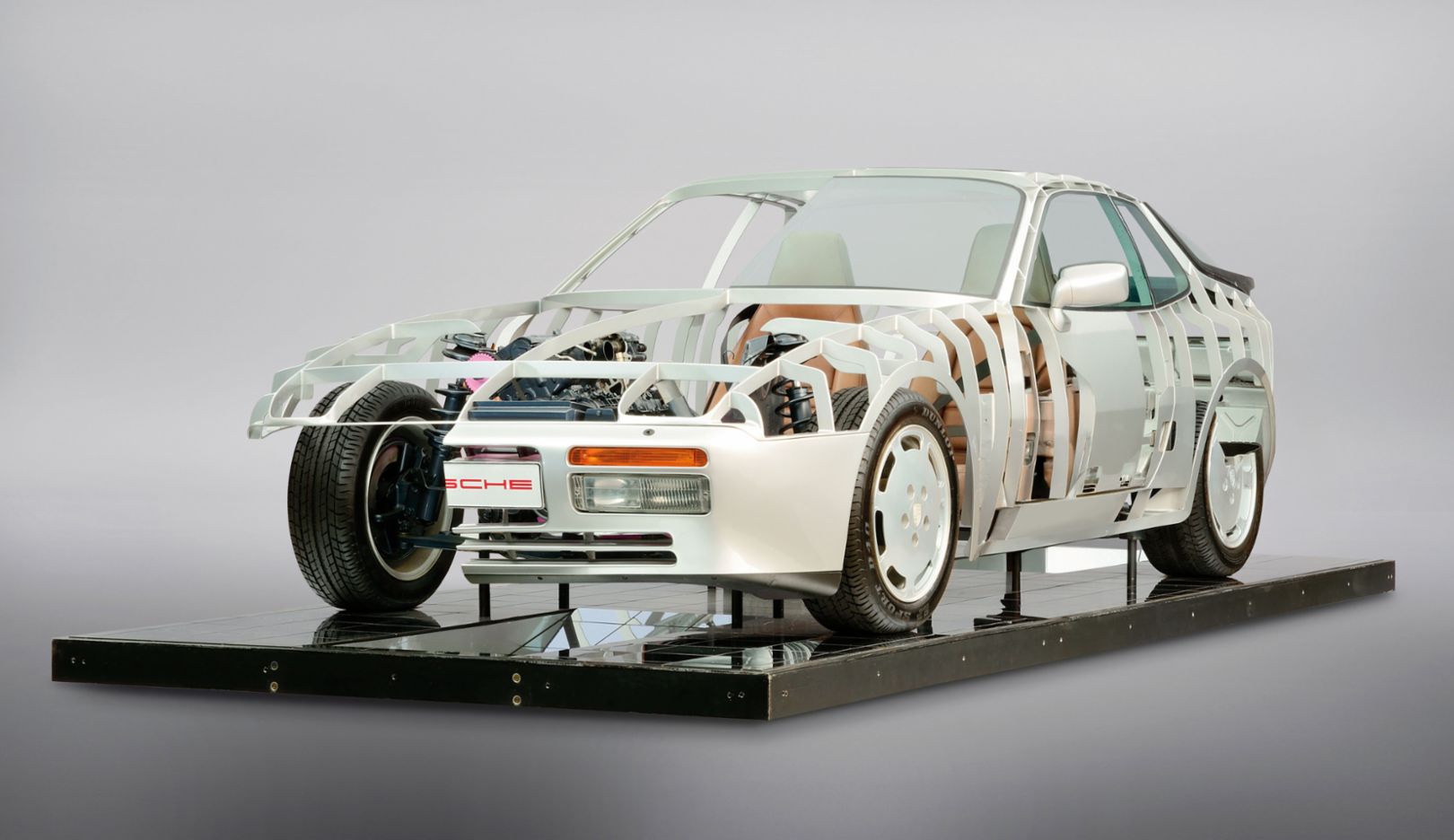
This cutaway model of a Porsche 944 with transaxle components painted in pink was built in the 1980s for demonstration and teaching purposes.Well-balanced axle load distribution – ideally a ratio of 50:50 – offers extraordinary benefits, especially when it comes to sports cars, as it ensures that both the steering inputs and the driving forces are transferred with precision and efficiency to the road via the front and rear axle, respectively. Balanced load distribution largely prevents oversteering and understeering from the outset. In addition, a car balanced in this way is much safer and easier to drive and handle – even for people without a racing license.
In addition, the design features a rigid transaxle tube extending from the front to the back, which increases passive safety. The forces absorbed by the crumple zone at the front or back are dissipated along the rigid connection during a collision, effectively bypassing the passenger cell and protecting vehicle occupants. “The transaxle design was not only revolutionary in terms of driving dynamics, but also a core component of body structure from the very start,” explains Hermann Burst, the former Head of Bodywork Testing at Porsche. Additional benefits of the principle included the comparably spacious interior with four seats and a luggage compartment that, for a sports car, was unmatched in size – with more than twice as much space as the 911. The design therefore also appealed to a completely new customer base.
Gear mechanism:
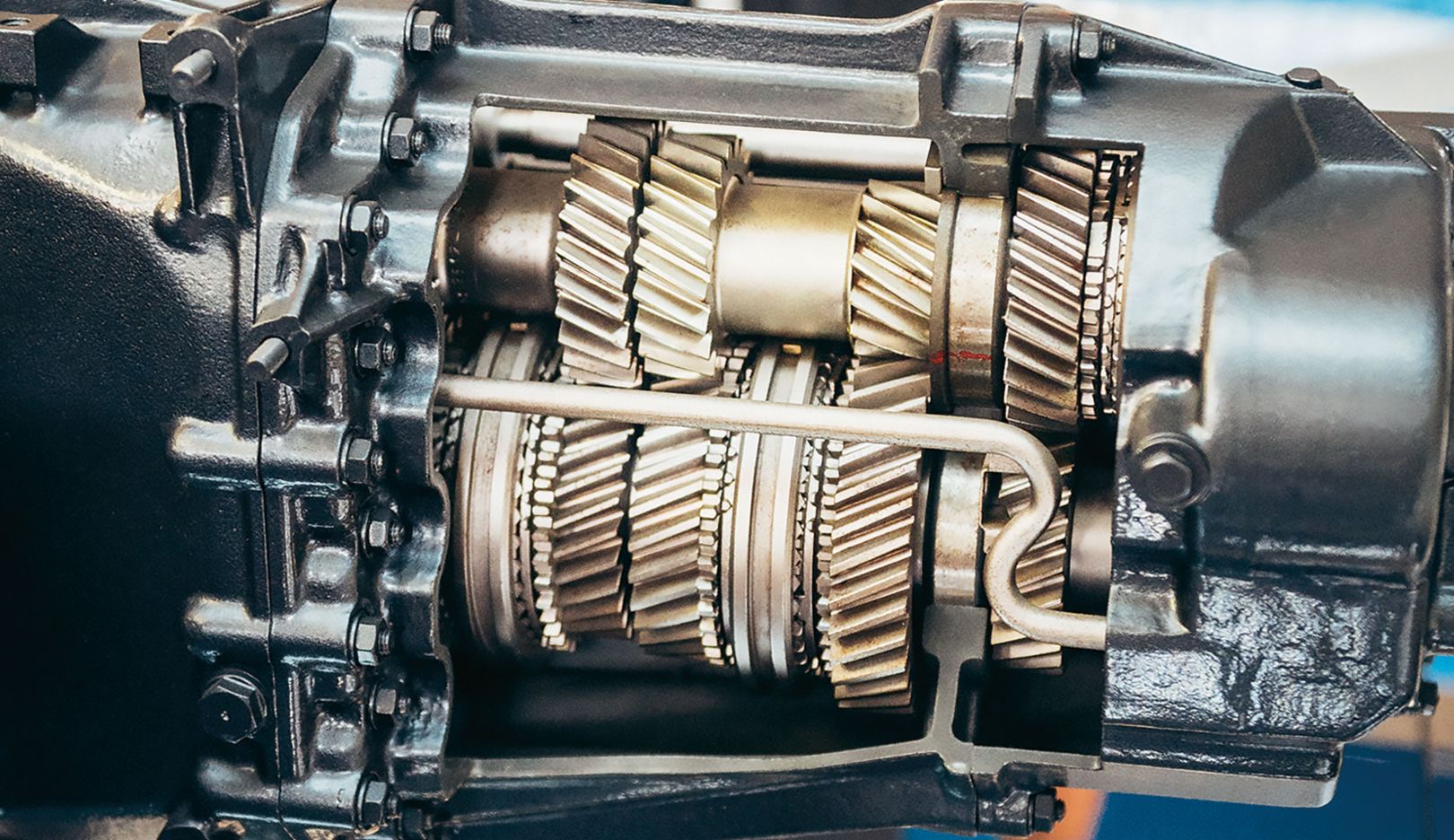
The Porsche 944 came as standard with a five-speed manual transmission at the rear axle.What makes the transaxle benefits so remarkable is that they were achieved at a time when there were not yet any electronic drive and chassis systems. Engineer refinements alone were responsible for the extremely neutral driving behavior and effortless control, which impressed the automotive world. In fact, an international jury named the 928 “Car of the Year” in 1978.
And the technology continues to impress to this day. Frank Babler, who has worked for Porsche for the past 36 years and was heavily involved with transaxle models early in his time with the company, has been driving a 944 S2 for 22 years. “The car’s roadholding and tracking stability are extraordinary,” says Babler. “Its driving behavior is so fresh, sporty, and effortless. You’d never guess that it’s so old.”
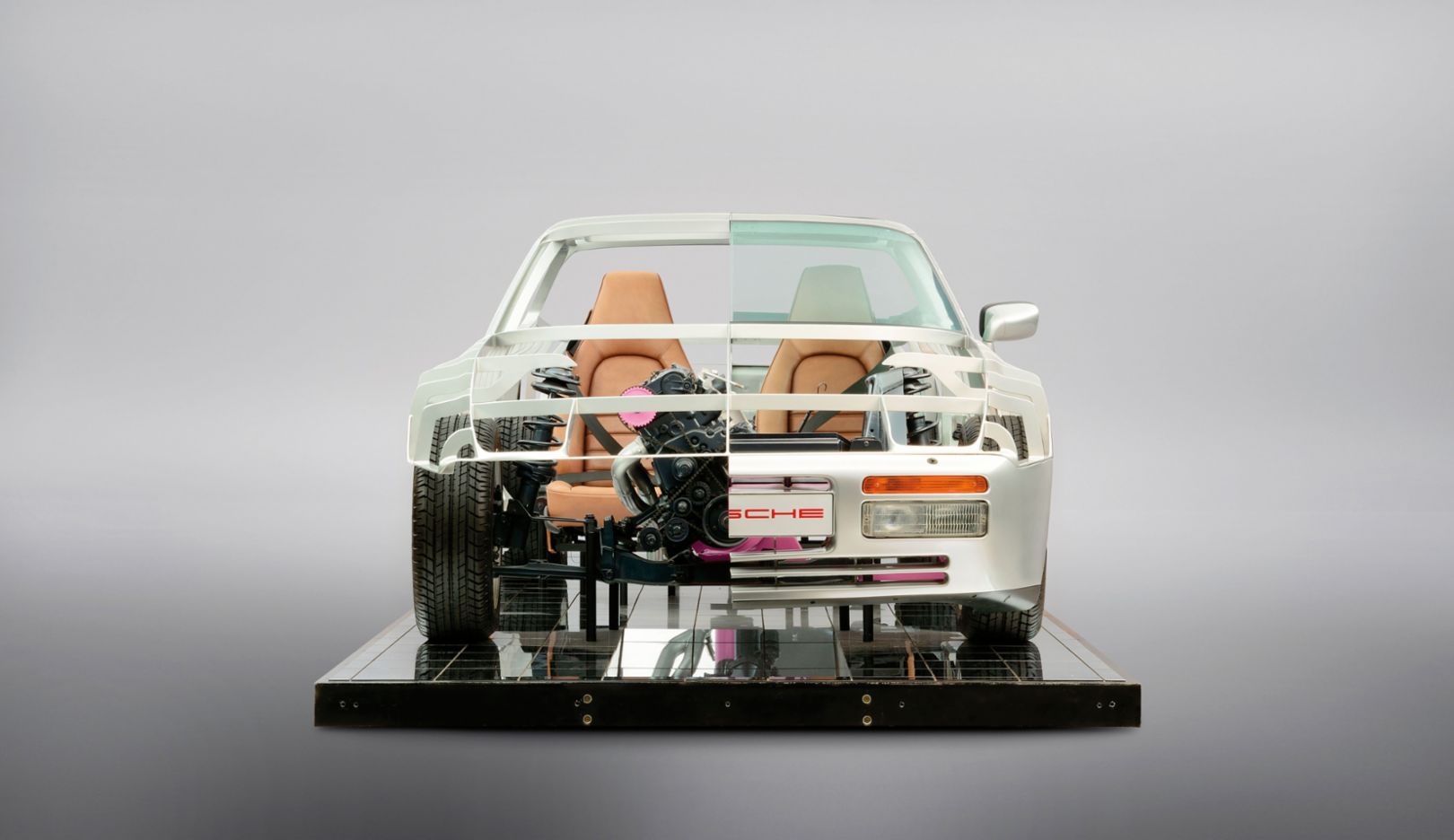
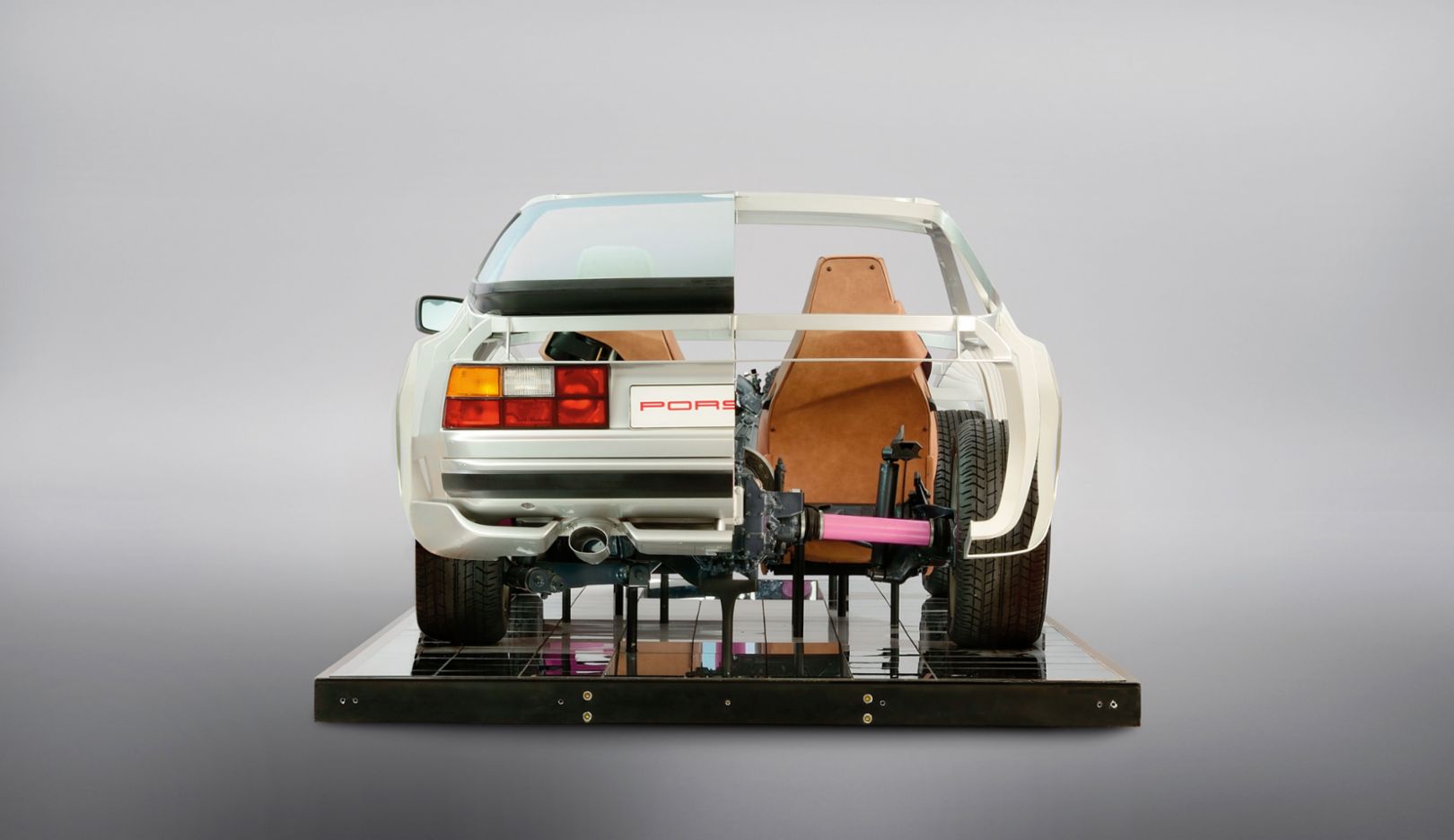
The 944 series, a further development of the 924, was produced from 1981 to 1991, while the S2 variant appeared in 1988. The water-cooled, three-liter four-cylinder engine positioned at the front delivered 155 kW (211 PS), and its in-line four-cylinder engine represented the largest displacement four-cylinder in a production car at that time.
The fascination of transaxle models stems directly from the relaxed yet precise, always manageable handling described by Frank Babler – and from the combination of everyday usability, driving comfort, and engineering purism, which still speaks for itself to this day. After all, the concept of physically separating the engine and transmission belongs to the category of technical innovations that, with minimal effort, can overcome several challenges at once. That said, it was no coincidence that it was Porsche designers of all people who had the courage back then to turn sports car design on its head. An approach that will never go out of style.