The Freedom to Just Keep Going
Extreme swimmer and world-record holder Andy Donaldson has conquered just about every challenge the open ocean can offer. Now he’s spending nine days behind the wheel of a fully electric Macan 4S, crossing Australia’s vast outback before taking on his next feat: swimming a crocodile-infested river.
For Andy Donaldson, the marathon before the marathon is surprisingly comfortable. At least by his standards. The endurance athlete settles into the driver’s seat of the Macan 4S, preparing to cover a grand total of around 7,000 kilometers across Australia. His destination lies in the continent’s remote north: the Ord River, home to countless crocodiles. That’s where he plans to swim – for roughly 55 kilometers.
The drive gives the 35-year-old plenty of time to prepare mentally. He and his team set off from Perth in a fully loaded, all-electric SUV, following the Western Australia EV Network, the country’s longest charging network. Stretching from Mundrabilla on the South Australia border to Kununurra in the far north of Western Australia, the route spans some 7,000 kilometers and features more than 100 fast and ultrafast charging stations at 49 locations. With its all-wheel drive, power of around 380 kW (516 PS; Macan 4S (WLTP)*: Electrical consumption combined: 20.5 – 17.7 kWh/100 km; CO₂ emissions combined: 0 g/km; CO₂ class: A), and a combined WLTP range of up to 611 kilometers, the Macan 4S was built for journeys like this. And for people like Donaldson: “Porsche approaches its work the same way elite athletes do. Nothing less than the very best is good enough.”

Built for endurance:
Andy Donaldson and the all-electric Macan 4S covered more than 7,000 kilometers across Australia and the Australian outback.Donaldson and his team meticulously planned the journey to make the most of the charging infrastructure. With stations at least every 200 kilometers, the Macan’s range was never a concern. Even so, he says, you always have to factor in the possibility that a charging station might be out of service. “It’s just like ultraswimming: Preparation and planning play a huge role in determining success.” The first 900 kilometers of the road trip follow the coastline of the Indian Ocean. As fiery-red desert landscapes and surreal limestone formations drift past the window, Donaldson reflects on how he became an extreme swimmer. The son of an Indonesian mother and Scottish father spent much of his childhood in competition pools and came close to qualifying for the Olympic team. In 2013, he moved to Perth to pursue his professional ambitions, but after falling short of selection for the sport’s top teams, he retired from competitive swimming in 2016. Instead, he earned a business degree, traveled the world, and even worked as a volcano guide in Nicaragua. Then, in 2020, he returned to Perth – and back to the water. To stay physically and mentally fit, Donaldson began teaching swimming. He encouraged his students to set ambitious goals and never stop pursuing their dreams. At the same time, he decided to lead by example.

“I was swimming in the ocean one day and realized it awakened something completely different in me than swimming laps in a competition pool,” he recalls. “That was the moment I understood just how deeply I loved swimming and the positive impact it had on both my physical and mental well-being.” It marked the beginning of a new chapter in my career.
Swimming for a greater cause
After 10 months of intensive training, Donaldson entered the Rottnest Channel Swim, a 19.7-kilometer open-water race from Cottesloe Beach in Perth to the sandy white shores of Rottnest Island. Despite lining up against some 2,000 competitors, including members of Australia’s Olympic team, he achieved something he never imagined possible. “I won the race by about 700 meters.” Yet the victory wasn’t what inspired him most – what mattered was that it gave him the opportunity to help others. Through the event, Donaldson raised the equivalent of about 7,000 euros for Kai Fella, a Perth-based mental health charity. “Mental health affects everyone, either directly or through someone close to them,” Donaldson says. “Swimming has shown me firsthand how sport, community, and time spent in nature can improve mental well-being.” Looking back, he sees the Rottnest Channel Swim as the turning point. “It created a wave that carried me toward every challenge that followed in open-water swimming.”

The power of community:
“If there’s one thing I’ve learned, it’s this: No one becomes who they are on their own,” says Andy Donaldson. “The people around you shape who you become.”
We find out what he means by that on the next day of his road trip through the outback. Today’s route covers another 860 kilometers east to Port Hedland in Western Australia. Donaldson and his team treat charging stops every 250 to 400 kilometers as welcome opportunities to stretch their legs, answer emails, and explore the surroundings a bit. “For me, charging doesn’t interrupt the adventure,” Donaldson says. “It’s part of it.” Back on the road, Australia’s spectacular landscapes continue to unfold before them. The Macan 4S passes ancient massive mountain ranges and the turquoise waters of Ningaloo Reef, a UNESCO World Heritage Site. Eventually, the marathon swimmer tears his eyes away from the scenery to describe the forces of nature that awaited him after his victory in the Rottnest Channel Swim: Ocean’s Seven, widely regarded as the ultimate test for long-distance swimmers.
Like German swimmer André Wiersig (see Christophorus No. 395), athletes attempt to cross some of the world’s most demanding stretches of open water, alone and without assistance. They battle icy water, relentless seas, and dangerous marine life. Even the sport’s most accomplished swimmers often need years to complete all seven crossings. Donaldson, however, completed the Ocean’s Seven within a year – the first person ever to do so. As if that wasn’t enough, his combined time of 63 hours and two minutes across all seven swims also set a new record.

Soaking up the sun:
Andy Donaldson taking a break en route. More than 100 fast and ultrafast charging stations line the Western Australia EV Network, a 7,000-kilometer-long highway.Pushing beyond the limit
His passion is almost palpable as Donaldson, behind the wheel of the Macan, talks about the countless hours he has spent in the ocean. “I love being close to nature, the unpredictability, and even the solitude.” And then there is the water itself. Sometimes it’s bitterly cold, threatening complete hypothermia. At other times, it possesses almost healing qualities. “Unlike swimming in a 50-meter pool, open water pushes you to your physical and mental limits.” At the same time, he treasures the opportunity it gives him to think – especially at night when the sea “begins to glow like the Milky Way, and every stroke feels as though your fingertips are dipping into golden dust. The ocean teaches you gratitude, for what you have and for the world around you.”
A similar feeling accompanies Donaldson on the third day of his drive to Ord River. Driving from Port Hedland to Broome, the Macan crosses vast salt flats and wetlands before stopping at Eighty Mile Beach, where pink and orange sunsets transform the coastline. For Donaldson, it’s the visual highlight of the road trip. His Ocean Seven’s tour, however, was not without moments of profound hardship. One of the most dangerous came in Hawaii’s Kaiwi Channel. Battling the unforgiving forces of the Pacific Ocean, Donaldson encountered a shark and accidentally swallowed a jellyfish. At two o’clock in the morning, 900 meters above the seafloor, he came to realize that he hadn’t moved a single meter forward in two hours because the current was pushing him back. Trying to swim against it, he says, felt “like a rag doll being tossed around inside a washing machine.”

Going the distance:
Andy Donaldson’s record-breaking journey across the Australian outback is the ideal challenge for a long-range specialist like the Macan 4S.Any one of those ordeals would have convinced many athletes to climb into the escort boat – not Andy Donaldson. “It’s easy to give up when every part of you is screaming ‘Stop!’ You ask yourself whether it’s really worth it. But then I thought about all the people who believed in me when I was a child, and about the greater purpose behind what I was doing, raising awareness for mental health,” he explains. “That day in the Kaiwi Channel was the hardest of my life. But in extreme moments like that, everything comes down to you and the choices you make. Those obstacles strengthened my discipline and my perseverance. The mind wants to quit long before the body does.” For Donaldson, extreme situations are opportunities to discover what lies beyond his perceived limits.
Energy as a way of life
This thought lingers as the Macan brings Donaldson ever closer to his next extraordinary challenge. The final 1,050 kilometers from Broome to Kununurra, the longest daily stage of the entire journey, transform the road trip into something truly exceptional. The route through the Kimberley region ranks among Australia’s greatest outback adventures. Towering boab trees rise from ancient crimson gorges. “Out here, everything feels so primal. You can sense the raw energy of the place,” Donaldson says in awe.
Raw energy is a way of life, something of a lifeblood for the endurance athlete. He finds it in every challenge he undertakes, and it often pushes him to the very edge. That was certainly the case during his crossing of the Santa Catalina Channel in California, the penultimate swim of his record-breaking Ocean’s Seven campaign. By then, he was physically and mentally exhausted. In the days leading up to the attempt, he was sleeping up to 18 hours a day. On the boat ride to the starting point, he was reunited with his father, who had traveled from Scotland to support him. “He immediately saw how bad a shape I was in,” Donaldson recalls. “I told him I was totally exhausted. He said, ‘Just do your best.’” Of course, the swim was a nightmare. “But every time I turned my head to breathe, I could see him watching from the boat. He stayed there all night.” His father’s quiet presence gave him comfort and strength. It also reminded him of his grandparents, his greatest supporters, whose ashes had been scattered at sea. “So they were with me in every stroke, every kick, all the way to the finish. If there’s one thing I’ve learned, it’s this: No one becomes who they are on their own. The people around you shape who you become.”


Eyes and ears:
On his 55-kilometer swim along the Ord River, Andy places his full trust in his support team, safely guiding him past rapids, rock formations, and crocodiles.“Unlike swimming in a 50-meter pool, open water pushes you to your physical and mental limits.” Andy Donaldson
And now comes the Ord River. After covering a total of 3,625 kilometers and making 12 charging stops, the Macan and Donaldson’s team arrive on schedule at the river – 650 kilometers long and home to thousands of crocodiles. The river is inhabited by both freshwater crocodiles, which are generally considered relatively harmless, and saltwater crocodiles, which can exceed six meters in length, often weigh more than a metric ton, and rank among the world’s most dangerous predators. Safety, however, comes first, which is why Donaldson’s challenge takes place in the river’s upper reaches, where freshwater crocodiles are found almost exclusively. Escort boats form a protective barrier around the swimmer while paddle strokes and engine noise create enough disturbance to keep the animals at bay. Should a saltwater crocodile appear anywhere near the route, the support team at shore is ready to raise the alarm immediately.
The Ord River winds through the rugged wilderness of the Kimberley region in the far north of Western Australia. Having conquered the Ocean’s Seven, Donaldson’s goal is to set another record by swimming the 55-kilometer stretch from the Lake Argyle Dam to Kununurra’s Diversion Dam. The time to beat? 16 hours and 13 minutes. More importantly, he hopes his challenge will inspire children and young people, and shine a positive light on the local community and region.


Silent danger:
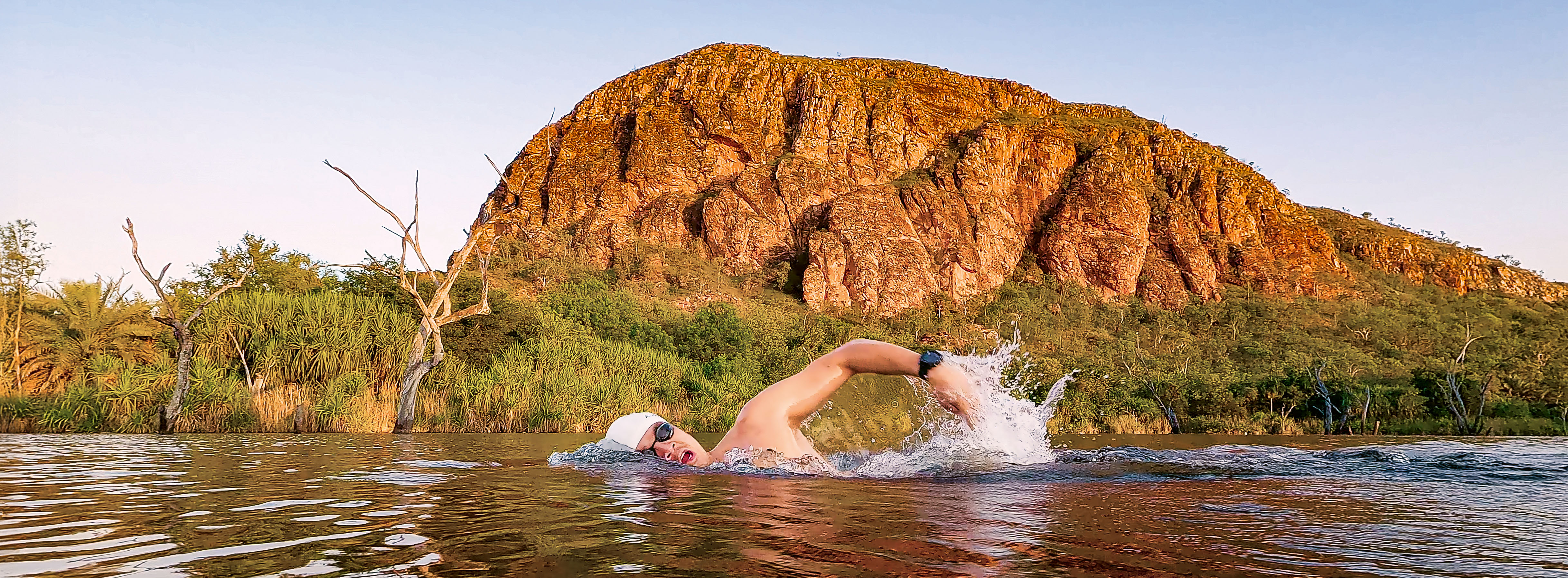
Seen from above, Andy Donaldson glides towards the record in absolute calm. But beneath the surface, the Ord River is teeming with crocodiles. Swimming in these waters represents the ultimate mental challenge, even for an extreme athlete.Between meditation and motion
Shortly before sunrise, at 5:30 a.m., Donaldson steps into the waters of the Ord River. The first thing he sees offers a glimpse of what lies ahead: a freshwater crocodile, around two and a half meters long. Later, he’ll admit that the sight made him nervous. But Donaldson’s ability to enter what he describes as a state of flow – “a magical trance somewhere between meditation and movement” – makes all negative thoughts of crocodiles disappear completely. This state is where he performs at his very best. “Just before you enter that flow, time seems to stand still for a moment. Everything becomes calm and runs completely automatically. It’s a little like the moment between being awake and dreaming.” In the Ord River, that sense of flow helps him master the course’s greatest challenges, including powerful rapids. To navigate safely around submerged rock formations, he relies on a kayaker serving as his eyes and ears through 55 kilometers of dark river water, guiding him along the safest route and steering clear of crocodiles. Despite extreme heat and dehydration, Donaldson reaches the finish after 11 hours and 51 minutes – a new record.

A hero’s journey:
The Macan 4S takes Donaldson across the outback to meet people in the most remote places. And carries his message with him: Mental health matters.And what about the crocodiles? “Apart from the one I saw getting into the water, I didn’t see another croc again,” he says with a laugh after recovering from the swim. His most memorable moments came during the closing kilometers when he felt “as though I had an elephant on my back” and the cramps were almost unbearable. Once again, it was the people around him who carried him through. Nearly 200 local residents had gathered along the riverbank to watch him finish. Children jumped into the water and swam beside him over the final stretch. “That really moved me. I hope I was able to inspire them, even if only a little.” Despite his exhaustion, he spent the following days providing free public swimming lessons, giving a presentation at a school, and participating in several community events.
The fact that it was a Macan 4S that carried him across Australia’s seemingly endless outback, enabling him to share his message with people living in some of the country’s most remote communities, feels entirely fitting to him. Donaldson points to Ferry Porsche’s famous observation that he couldn’t find the sports car of his dreams anywhere, so he decided to build it himself. For him, an expression that “embodies the very essence of purpose and determination.”