Christophorus Moments: The Beginning of One-Make Series Racing
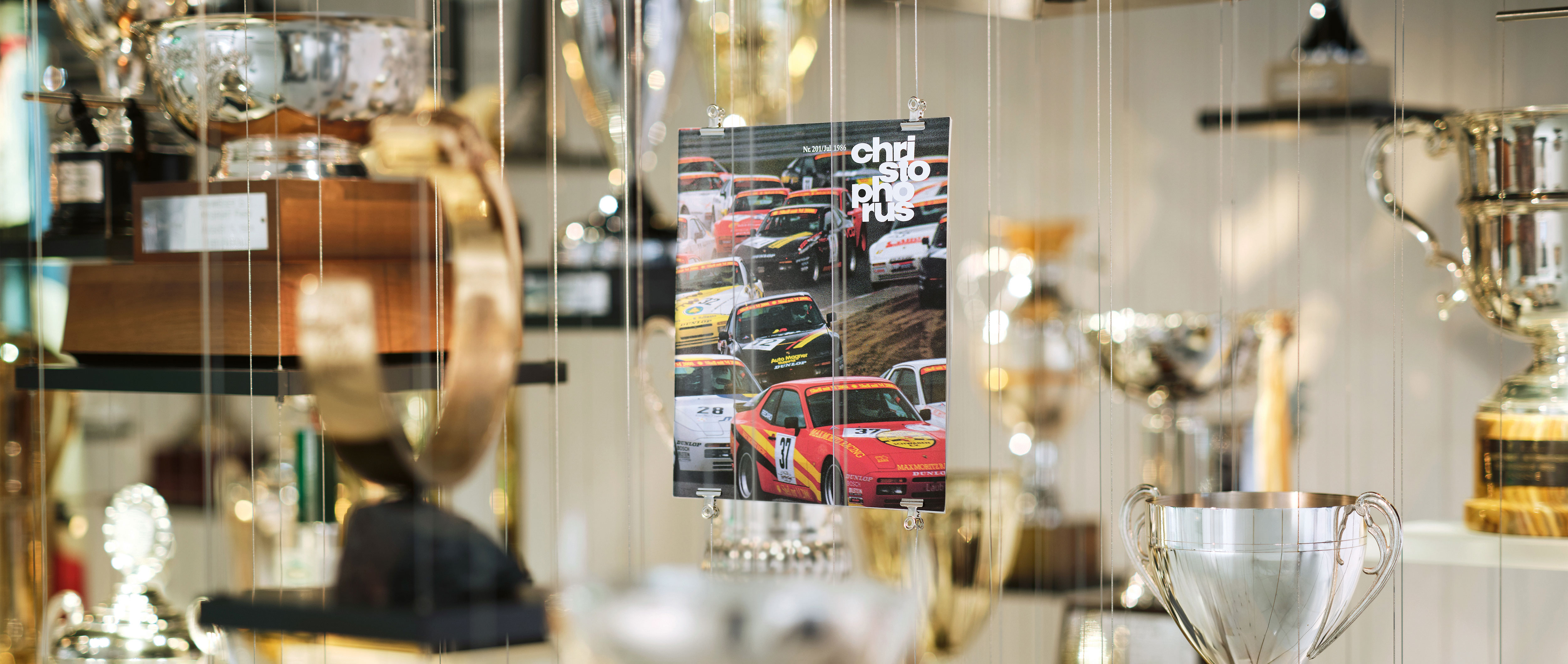
Launched in 1986, the 944 Turbo Cup sparked a fascination that continues to this day. A look back at issue 201 of Christophorus.
Issue: Christophorus 201
Year: July 1986
Topic: 944 Turbo Cup
“The car phone is going to be the next big thing.” – “With its aircraft engine, Porsche is about to really take off.” – “Studies by the Federal Highway Research Institute show that German autobahns are among the safest in the world despite largely having no speed limits (…).” Stories such as these from Christophorus issue 201 take us right back to the mid-1980s. And likewise the cover story at the time, showcasing the 944 Turbo Cup. Under the headline “Cup of Good Hope,” the issue focused on the first one-make series race held by Porsche, launched in 1986. “Young hopefuls, seasoned veterans, fierce competitors in the one-make series, and champions from yesteryear (…) all jumped on board immediately when Porsche called,” author Jürgen Pippig writes in his report. Thirty-nine identical 944 Turbo cars lined up in the very first practice session at Nürburgring. “Every car having equal power and the same technology was a surefire way of guaranteeing intense battles on the track,” says Pippig. “The kind of duels that spectators want to see.” The success of the practice session was also mirrored in the inaugural race at Nürburgring with the support of guest driver Hans-Joachim Stuck. And this led to a passion and interest that has held true to this day. In 1990, the Carrera Cup took the place of the 944 Turbo Cup and paved the way for the wide range of one-make race series organized by the sports car manufacturer today.
Cup of Good Hope
The Porsche 944 Turbo Cup is more than just a one-make series. Young hopefuls, seasoned veterans, fierce one-make series competitors, solid all-rounders, champions from yesteryear, future stars, technicians, marketing experts, and sponsors all jumped on board immediately when Porsche called. It is a Cup of Good Hope for all.
By Jürgen Pippig
“One of our hopes for this race series with environmentally friendly production cars is that we can get a better understanding of how the catalytic converter performs under full load and at high speeds.” This is how Porsche Head of Development Professor Helmuth Bott described the technical objectives and commitment of Porsche. The drivers (naturally) have a different goal in mind, such as Dirk Wagner, Renault 5 national champion and the youngest driver in the field at 22 years of age: “I chose the 944 Turbo Cup over another one-make series, as I think it’s the most challenging of all the race series from a driving perspective. If I do well, I hope it’ll help me take a step forward in my motorsport career.”
Harald Grohs from Essen, who has already demonstrated his speed on the track in numerous race series over the years, has a different type of goal: “I’m a battler who doesn’t shy away from a duel. Even at 42 years of age, I believe I can still hold my own against the younger drivers, and that’s why I set out to get a Cup car. My goal is to get overall victory. I have a sponsor who backs me, who covers the costs of my racing campaigns, and who supports the concept of an environmentally friendly one-make series. And on top of that, a new race series always gets a lot of public attention.” Dealers and racing teams are also pleased with Porsche’s commitment to grassroots motorsport. One team that warmly embraced the idea was Reutlingen-based Max Moritz, known in the 1970s for its impeccably prepared Porsche 935 cars in the Group 5 class of the time, before later withdrawing from motorsport due to soaring costs. Now, they have returned to the racetrack with four competition cars.
It was quite a level playing field in the Eifel Race at the new Nürburgring, when 39 identical 944 Turbo cars, largely with standard specifications, began their practice sessions – differing only in their colorful sponsor logos and creative designs.
Every car having equal power and the same technology is a surefire way of guaranteeing the kind of intense battles on the track that spectators want to see. To make things even more interesting, the organizing team led by Dieter Glemser decided to invite additional guest drivers. Each series race would feature a different celebrity driver. At Nürburgring, it was the turn of motorcycling star Martin Wimmer, who jumped at the opportunity to go from two wheels to four. “If I was going to take part in a car race, then I had to do it right away – while the rest of the pack was still warming up.” After the first practice session, which took place in the rain, the motorcycling ace was down in fifteenth place. His friend Hans-Joachim Stuck gave him some helpful advice and Dieter Glemser gave the signal to switch to slick tires at just the right moment during the second practice session. The track had dried out and was not yet sullied by oil or dirt from the other cars. This was Wimmer’s chance. And he took it. He recorded the fastest lap in practice, building a lead of almost a second ahead of his nearest competitor. The Porsche 944 Turbo Cup had its first major talking point: a motorcyclist ahead of all the car drivers. “I was shocked that it went so well. But I took the tips I got from Hans to heart,” the Munich native remarked. “On a motorbike, for example, you can brake hard right into the bend, almost all the way to the apex. But that doesn’t work in a car. It gets far too unstable and tends to break traction. You need to start braking while still on the straight and, as you turn in, get back on the throttle very early and with just the right amount of pressure.”
Wimmer had spurred on the pros, semipros, young pretenders, and amateur drivers, who were trailing him by just tenths, or even hundredths, of a second. Repeated calls for restraint at the first corner from Dieter Glemser and the team principals seemingly fell on deaf ears. The Yamaha factory racer who had voiced serious concerns before the start, suddenly found himself blocked off from both sides with no way out, and dropped back to fourth place. In rows of three and four, the rest of the field stormed toward the first chicane – blue smoke bellowed into the air, mirrors were torn off, signal lights shattered into a thousand pieces, and door handles scraped and rammed against one another with a grinding clamor. Wimmer was now on the racing line of Harald Grohs, who had started in ninth and was pushing hard to bring himself up the field. He unceremoniously barged Wimmer off the track, but in doing so also had to go through the run-off area himself. “My brakes hadn’t properly warmed up. I’m sorry about what happened. I also have to apologize to the other drivers whom I made contact with a few times during the race,” said Grohs meekly afterward.
Grohs and Wimmer, the latter of whom returned to the race in last position after a pit stop, were not the only ones to find themselves in the muddy grass at the side of the Nürburgring track. Some drivers slid off on oil slicks, while others asked too much of their Porsche 944, spinning off or grazing the guardrails. It was particularly unfortunate for those who didn’t suffer damage to their cars, but whose slick tires got stuck in the muddy areas. Two drivers cleverly managed to keep themselves out of the carnage: Joachim Winkelhock, brother of the much-missed Manfred Winkelhock, and Porsche factory driver Hans-Joachim Stuck, who completed a few laps outside of the official standings.
For the 26-year-old Winkelhock, the path to victory was now clear in the first Turbo Cup race, followed by Swedish Formula 3 specialist Bengt Trägårdh and Harald Grohs. Despite finishing well down the field a lap behind, Martin Wimmer showed the fans that the pace at the front would have been no problem for him.
Hans Stuck had a camera fitted to his 944 Turbo: “I recorded the key moments for posterity,” the reigning endurance race world champion said with a smile. He was full of praise for this series and the drivers who took part: “The standard and demands of this series are exceptionally high. I think it’s almost up there with the 1979 Procar series. The Turbo cars are fast and aren’t easy to handle when pushed to the limit. Once you take the car beyond the grip limit, it’s difficult to correct and spinning is inevitable. So I’m certain that the pros will prevail in the end.”
And that’s how it proved to be: When all was said and done at Nürburgring, seven cars were badly damaged, another 10 were in the shop for extensive repairs, and new fenders and doors were needed practically all round.
Ahead of the race at the Berlin AVUS circuit, the instruction was therefore to drive with care so as to keep repair costs down for the cars which were each worth 78,900 deutsche marks. A special meeting of the drivers was called, in which project director Dieter Glemser urged drivers to exercise caution. On the approximately four-kilometer-long straight at the AVUS circuit, the Turbo with catalytic converters can push fifth gear to its limit while driving in the slipstream. At the end of the straight there is a hairpin bend where drivers have to slow down all the way to first gear. Porsche customer advisor Theo Kapffenstein said: “Based on the gear-ratio chart, the cars reach top speeds of almost 270 kmh on the long straight. Neither myself nor some of my colleagues in Weissach would like to be caught up in that.” Annette Meeuvissen, Ford Ladies Cup champion and a battle-hardened driver, reiterated this: “We have to be very careful when we race along the straights in rows of four, just centimeters apart, using the slipstream before then possibly veering off. If someone makes a mistake or accidentally takes their foot off the gas, it could end badly.”
The Cup drivers at the AVUS circuit received high praise. Guest driver and fastest in practice Jochen Mass said: “The guys at the top are all really good. They drive hard, but fair. I didn’t ever actually want to be in the lead during the race. I wanted to be able to take stock of things from a safe distance and then strike at the final few bends. But at one of the final bends, a group of four cars suddenly slipped past me. I got wedged in and there was just nothing I could do.” Fifth place for Mass.
Some of the other drivers clearly also thought Jochen Mass’s approach was the correct one. Rare in a race of this kind, the lead tends to change hands multiple times on the AVUS circuit. Out in front all the way was Jörg van Ommen (23), starting the race for the Max Moritz team. He looked like the clear winner for a long time, before falling foul of an unfortunate mix-up: “I thought there was one more lap to go. That’s why I didn’t want to be in the lead coming into the final lap.” At Mainz-Finthen, he drove a perfect race from start to finish, fastest in practice and first across the finish line.
There was more AVUS misfortune for another fast driver who had established himself around the top of the standings: Roland Asch. The touring car specialist, who always jokingly complains about his engine’s lack of power at Porsche, made contact with Jochen Mass on the straight. Swabian native Asch said: “There are no real tactics for these Porsche races. You need to be fully focused from the first to the last lap, go full throttle the entire time, and never leave any gap where you can be overtaken.” He succeeded in this in Mainz and was second across the line.
“The main challenge is how you control brake pressure if you want to brake optimally all the way to the final lap,” says Porsche veteran and former champion Edgar Dören, who is well established just inside the top half of the field. There is therefore no perfect formula for superfast laps with the Cup version of the 944 Turbo. It simply calls for complete commitment and high risk, yet the margin between grip and loss of control is small. Professional driver Harald Grohs (Obermaier Racing) found the best compromise. After the start of the race, he dropped back to eighth in Berlin, kept his distance, then gradually and doggedly battled his way back to the front, before suddenly finding himself in the lead coming into the third-last corner of the race, ahead of Joachim Winkelhock (Team Strähle) and Jörg van Ommen.
The spectators at Nürburgring, in Berlin, and at Mainz-Finthen watched on with great delight. And there was another Sunday treat for the passionate fans in the grandstands in Berlin, as a huge multi-vision screen broadcast crisp, color images from the south bend, four kilometers away. The giant screen was a resounding success, and something that all race organizers would do well to consider installing. This is the way to present motorsports in this day and age.
The same applies for the 944 Turbo Cup: It offers exciting battles up close and personal, where anyone can beat anyone, along with financial incentives for the drivers (5,000 deutsche marks for the winner). The precise inspections carried out by the technicians from Weissach ensure that there are no irregularities of any kind. For everyone involved, young hopefuls, seasoned veterans, fierce one-make series competitors, solid all-rounders, champions from yesteryear, future stars, technicians, marketing experts, and sponsors, this is truly a Cup of Good Hope that has met every expectation after the first few races.