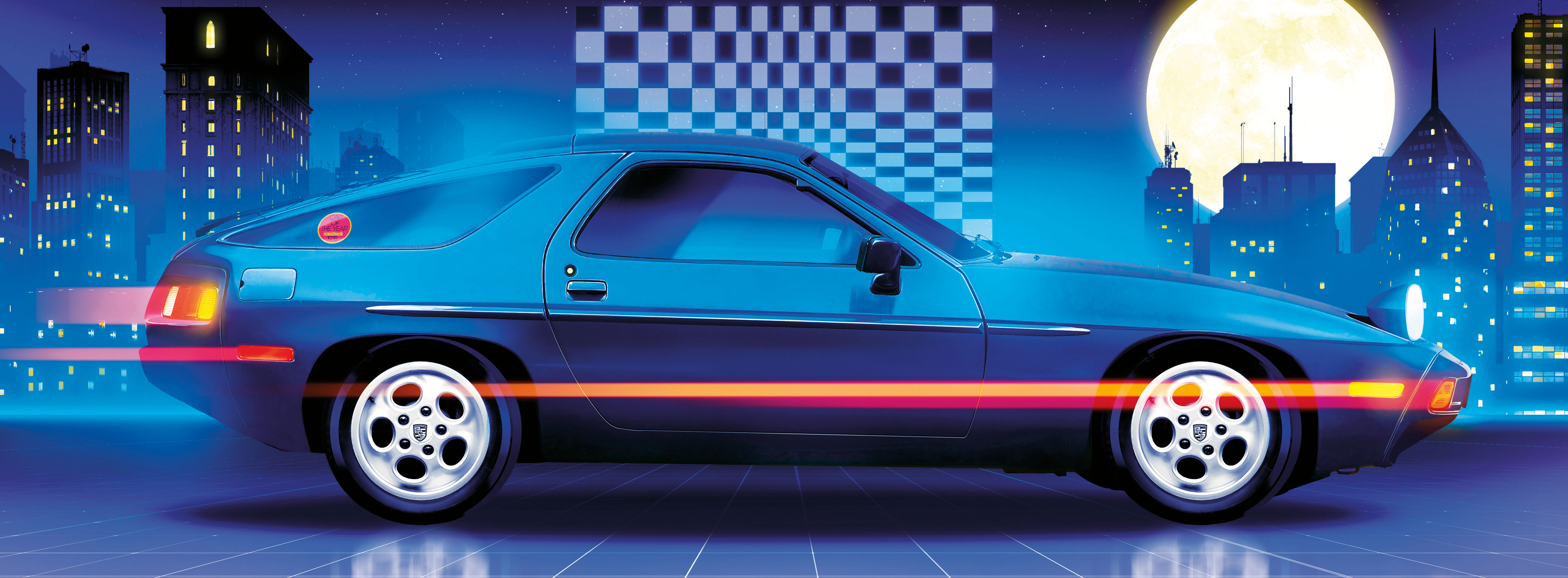
A Time of Clarity
The 1980s marked the beginning of the evolution from an analog industrial world to digital modernity, which brought greater visibility to technology and established it as a lifestyle element. This decade continues to fascinate to this day. It was an era shaped by music, fashion, design, and the self-image of a society searching for clarity, without losing sight of progress. The car, too, evolved into a conceptual embodiment of the time. In fact, Porsche’s transaxle models were a product of this mindset – a response to an era eager to embrace change.
Like pop culture and everyday life, cars, too, evolve.
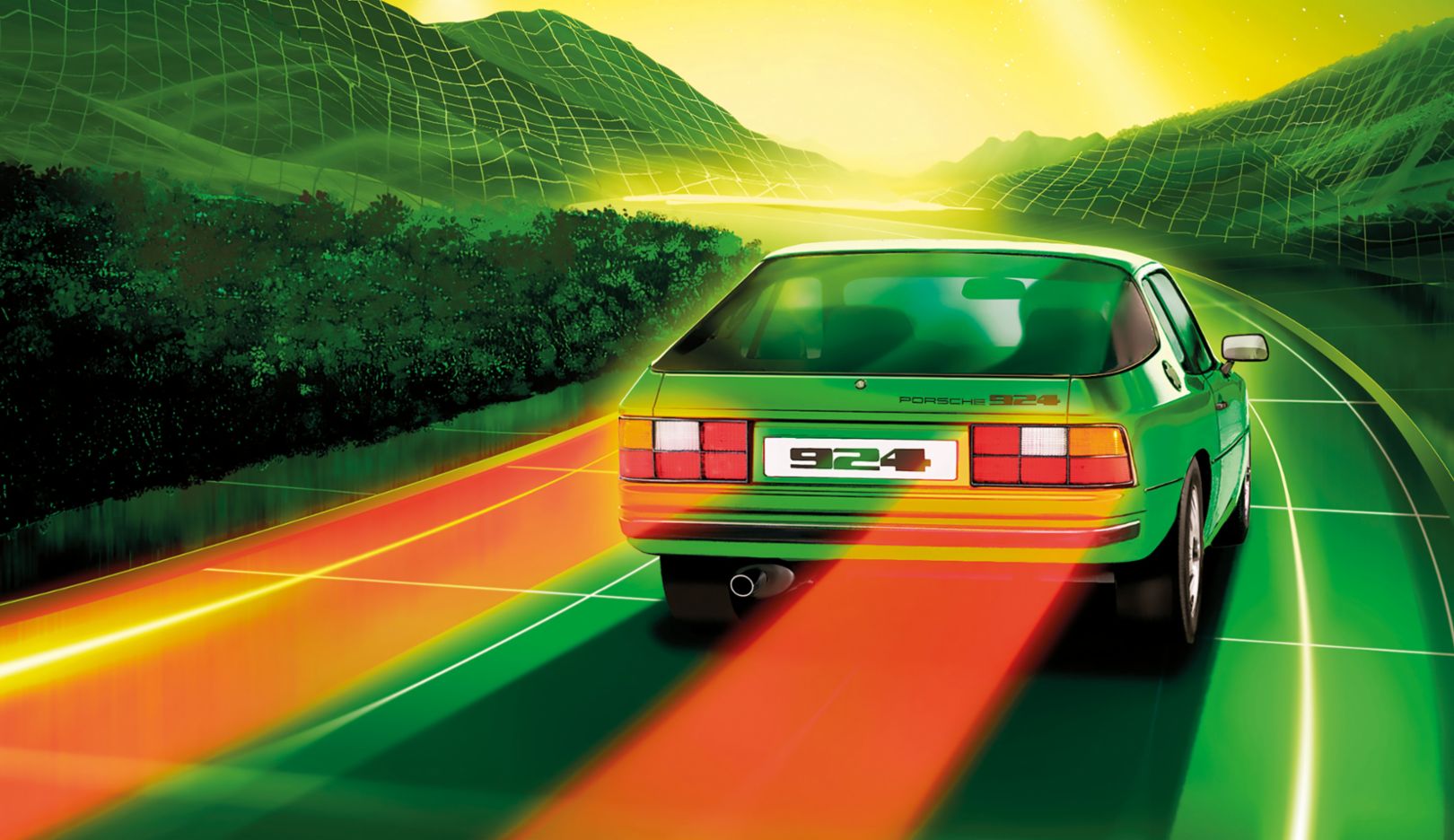
The 1980s didn’t change the world as much as they changed the way in which it was viewed. Technology became an integral part of everyday life and shaped the perception of time, function, and the future. Humanity found itself at the dawn of the digital age. During this period of transition, when the world began to think differently, Porsche made the decision to expand on its vision of the sports car – not with a radical cut, but with a deliberate redistribution of weights. The transaxle architecture was a prime example of this shift in thinking. The spirit of the sports car was inspired less by physical appearance than technical feasibility.
Many of the aesthetic elements of the 1980s like neon colors, graphic patterns, and technical-looking typographies are a manifestation of more fundamental changes. In an environment of oil crises, economic stagnation, and the Cold War, the Western world was hungry for stability and a new sense of trust in systems – and ultimately pinned its hopes on progress. Store shelves were stocked with new devices, fueling a different perspective of everyday life. Energy prices remained high, people were beginning to understand that resources are limited, and international markets grew less and less predictable. Technological innovation increasingly focused on people.
The first personal computer introduced a new way of thinking inside the home. Programmers learned to identify cause and effect and understand the big picture. Devices like the Commodore 64 and Apple II promoted learning and experimentation and served as entertainment media. Technology was no longer an invisible service provider, but something you could interact with – an experience that shaped a whole generation. You can begin to understand systems if you give them a chance.

New devices, new habits
While the computer established a new understanding of controllability, the Walkman supported the concept of individual mobility. For the first time ever, people could create an acoustic world separate from the environment, without having to leave it. The Walkman made music portable and, with it, your state of mind. Now anyone could choose a soundtrack for specific moments of their life. Music assumed the form of a personal sphere in motion. The sound of the cassette clicking into place, the brief hiss before the start of the song, the act of turning the tape over – interaction became a requirement for participation.
At the same time, the VCR established itself as a key technology in the living room, its arrival changing viewing behavior once and for all. Time was suddenly easier to structure. The VCR allowed viewers to stop the movie, rewind, and get a better look. Images were now more accessible and less fleeting.
Pop culture as a reflection of technological processes
Even the sound of the world changed. Synthesizers, sequencers, and drum machines conquered studios and, a short time later, private spaces. Pop culture responded immediately to the availability of new technologies. Music could be produced more clearly and with better control. Bands like Depeche Mode began working with machines, without removing the human touch. In fact, melodies were suddenly more concentrated, lyrics more direct. Music was no longer just a form of expression, but could be produced with greater intention. Pop reflected a mindset searching for structure without limiting creativity, a perception only reinforced by the launch of MTV. Music videos created a visual space in which aesthetics were suddenly just as important as sound. Artists began thinking in terms of scenes, colors, and movements. Pop expanded into the visual sphere, with image and sound merging together to create a vibe that inspired melancholy and fascination.
The 1980s are a popular backdrop for movies and series today. For example, the Stranger Things series, which launched in 2016, is set in a small town and centers around kids and teens, scientific experiments, government institutions, and an invisible threat to everyday life.

Rather than something abstract, the series presents technology as something tangible in the form of walkie-talkies, CRT monitors, analog measuring instruments, cables, and switches. Plans are drawn out by hand, connections explained. The world follows clear rules. And that’s precisely the source of the suspense.
Cinema of the 1980s discovered the future as a backdrop. Movies like Back to the Future (1985) play with time travel within plausible parameters. People believed in progress, but also wanted to understand it. And to make it clearer, worlds were invented that painted the future not only as a possibility, but also as a threat. Taking a critical look at present-day developments is what shapes the future, which is why dystopian stories strike a nerve with the audience. Movies like Blade Runner (1982), Terminator (1984), and RoboCop (1987) explore the dangers inherent in technological progress.
The 1980s were optimistic, but not naive, as progress also promotes fear. You need to confront fear to conquer it. Even the fashion of that time reflected this self-image. With clear lines, structured cuts, and technical materials, clothing was less decorative than an expression of a certain attitude. Women and men donned shoulder-emphasizing cuts, synthetic materials, and expressive colors to demonstrate that they were part of a movement that looks to the future.
Usability as a principle
Like pop culture and everyday life, cars, too, evolved in the 1980s and were increasingly viewed as technical systems, with interiors that followed the logic of that time. Fashionable materials defined aesthetics; cockpits were streamlined; and instruments clearly structured. The first-ever onboard computer provided data on consumption, range, and average speeds. Featuring hi-fi car stereos with graphic equalizers, tape decks with soft-touch buttons, and eventually CD players, the car evolved into a mobile technology hub, an extension of the living room of a tech-loving society.
It was also this environment that paved the way for transaxle models. While they may not have been the defining stars of the decade, they were influential companions and today embody the true spirit of the 1980s. It all began with the 924, which debuted in 1976 and eventually became a familiar sight on the road in the decade that followed. The 924 opened the brand to new target groups, established the transaxle architecture in everyday life, and embodied a sports car concept based on a new balance: engine at the front, transmission at the back. The 928 and 944, launched in 1977 and 1981 respectively, continued this idea, combined performance with suitability for everyday use, and became the brand’s economic pillars. Continued development resulted in the 968, which made its debut in 1991 and demonstrated the maturity of a consistently applied principle.

The desire for clarity
When it comes to understanding the fascination of the 1980s, it’s less about the individual vehicles than it is about the climate in which they existed. They navigated cities with glass facades, neon lights, and advertisements that gave structure to the night. They parked in front of office buildings with the first computer workstations. They transported people who worked with tables, numbers, and programs during the day, but spent their evenings listening to music that in some cases was produced with the same machines. Looking back, these years feel like a phase of radical change. Analog knowledge meets digital thinking. Back then, devices had visible mechanics, making it easier to explain their function. People were curious about how things worked, not just that they worked. This clarity had a stabilizing effect and shaped the design of the transaxle models.
A new, tangible relationship between person and machine developed in the 1980s, laying the groundwork for the future. What matters most is not the change itself, but how you shape it.