A New Era of Timekeeping
At the heart of Switzerland’s legendary watchmaking triangle, Porsche Design has opened its new timepieces manufactory. Both the region and the building itself are steeped in centuries of horological tradition, while the state-of-the-art facility produces precision chronometers with the efficiency and discipline of Porsche’s manufacturing principles, creating exclusive, one-of-a-kind timepieces.
For Christoph Fröhlicher, the workday sometimes begins in the “supermarket.” There are no groceries or checkout counters here – instead many neatly organized shelves and drawers full of components. List in hand, Fröhlicher pushes a small cart down the aisles, collecting one watch part after another: a titanium case here. A leather strap there. A cobalt-blue lacquered chapter ring. A tiny container holding five miniature screws. Every component, from the movement and hands to the rotor cap, has its assigned place in one of the boxes on the cart. Once a box is fully packed, it contains everything needed to assemble a chronograph with Porsche DNA – more often than not, that chronograph will be one of a kind.
“Nearly three-quarters of our timepieces are unique pieces, individually configured to each customer’s specifications,” explains Rolf Bergmann, CEO at the Porsche Design timepieces manufactory. Standing one floor below the “supermarket,” Bergmann is in the configuration lounge inside Porsche Design’s new watch manufactory, which opened in 2026. While the workspaces upstairs are bright, clinical, and impeccably clean, warm colors and premium materials define the space here – and not just in the furnishings. This is where Porsche enthusiasts and watch collectors can create timepieces individually tailored to their own 911 or Cayenne.

A passion for precision:
Even after three decades in the profession, Production Manager Christoph Fröhlicher remains captivated by the meticulous craftsmanship at the watchmaker’s bench and the perfectly balanced heartbeat of a newly completed mechanical movement.Customers compare color samples that perfectly match their vehicle’s paint finish. They feel the texture of leather straps crafted from the very same hides used for the seats of their sports cars. And they discover why the winding rotor inside a mechanical timepiece is much more than a faithful miniature of a 911 alloy rim: Although the latter must be perfectly balanced, the rotor must be anything but. “We add tungsten weights to the wheel-inspired rotor to deliberately create an imbalance that keeps the automatic movement wound,” Bergmann explains.

Zero margin for error:
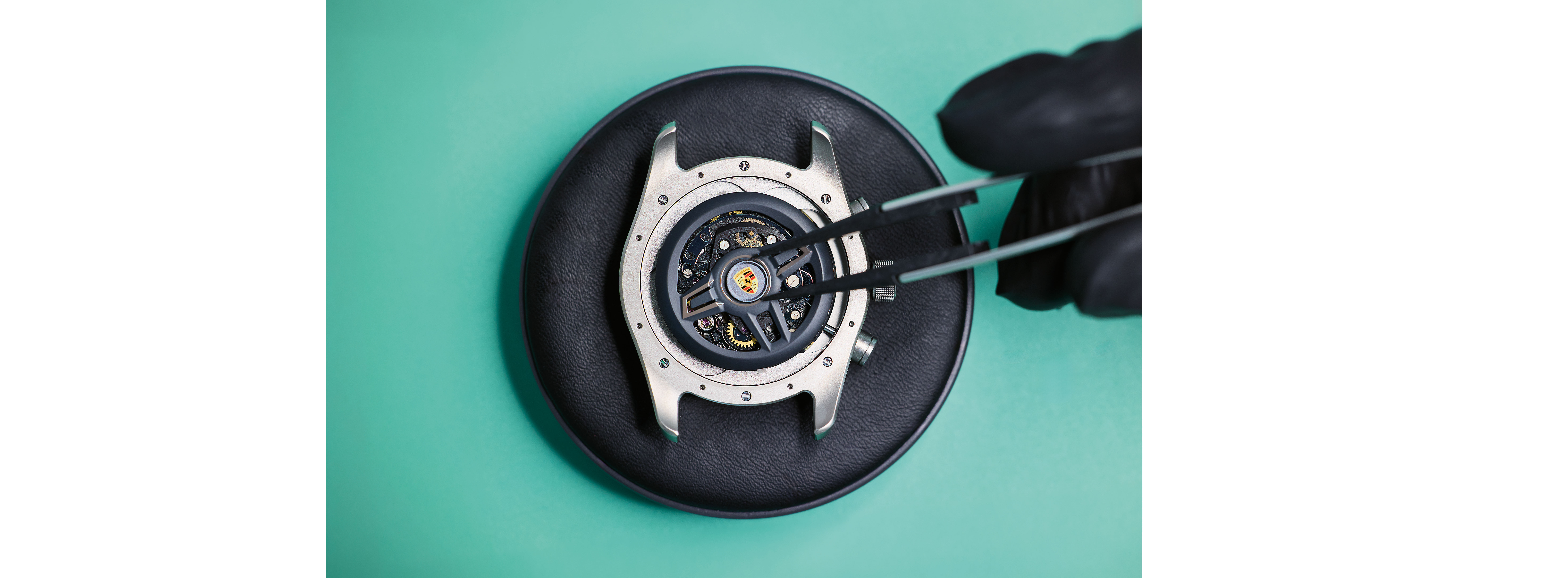
In the clean room, the watchmaker manually positions each hand on the dial with unwavering concentration. Custom-calibrated precision tools, individually adjusted to the manual pressure of each watchmaker, ensure that every hand sits at the right height and aligns perfectly at zero.The unconventional rotor and the countless samples of colors and materials displayed throughout the lounge perfectly embody Bergmann’s mission. His role is to unite two worlds: Porsche’s exclusive sports cars and its equally exclusive timepieces.

The perfect setting:
Originally built in 1955, the manufactory in Grenchen has been completely transformed for Porsche Design and equipped to the most advanced technical standards. It stands at the heart of Switzerland’s watchmaking triangle, surrounded by the stunning landscapes of the Jura.Before moving to Switzerland, the production and logistics engineer spent years in Zuffenhausen, where he led the integration of Porsche Exclusive Manufaktur options into the production line. Whether it was specially painted exterior mirrors or personalized monograms embossed into headrests, his task was to translate highly individual customer requests into an efficient manufacturing process. “I came to Switzerland to bring those same principles into the world of watchmaking,” says Bergmann. “Our new manufactory has been perfectly designed for this.”
Unlike the previous facility in nearby Solothurn, which had reached the limits of its production capacity, the new site in Grenchen allows Porsche Design to fully implement Porsche’s highly efficient manufacturing philosophy. Over an 18-month period, the 3,600-square-meter building was completely renovated, designed from the ground up around just-in-time logistics and short production paths. The entire workflow follows a U-shaped layout so that every step flows seamlessly into the next – from component picking in the “supermarket” to the 10 watchmakers’ workstations inside the ISO-certified clean room, illuminated by specialized LED lighting, and finally to quality inspection.

Shopping for parts:
In the “supermarket” next to the manufactory’s clean room, a watchmaker gathers the precise components required for a customer’s bespoke timepiece, following a detailed checklist. This example features a blue chapter ring.Yet the facility is remarkable for more than its technical sophistication. The building from 1955 itself has deep ties to Porsche’s history. From 1998 to 2014, Eterna manufactured Porsche Design watches here under license. And just two streets away, in 1972, F. A. Porsche had his very first timepiece produced: the now legendary Chronograph 1. “In this building, with all its history, we’ve given our founder’s vision a new, permanent home,” Bergmann says.
That home, in turn, lies at the center of Switzerland’s world-famous watchmaking triangle. Around 1850, this farming village with some 1,500 residents grew into a global hub of the watchmaking industry. “What drove the transformation was a series of poor harvests that left farmers impoverished,” explains Monika Bruder, who regularly leads guided tours on the history of watchmaking in Grenchen. Early attempts to establish straw-weaving and silk-spinning industries failed to provide a lasting economic future. Salvation ultimately came from Dr. Josef Girard, a physician and politician who introduced watchmaking to the community as a new source of livelihood. What began as a cottage industry, with farmers assembling watches at small workbenches in their homes, gradually evolved into the town’s first factories, bringing employment and prosperity. “A century later, more than 22,000 people were living and working here,” Bruder says.


She tells the story standing inside the city’s Museum of Cultural History, where this evolution unfolds across three floors, from exhibits recreating the home workshops of the earliest watchmakers to the mid-century furnishings that found their way into the living rooms of the newly prosperous watchmaking town in the 1950s. Visitors arriving in the region for the first time are often initially struck by the natural beauty of Grenchen and its surroundings. Nestled between Lake Biel, with its gently sloping vineyards, and the dramatic limestone cliffs of the Jura Mountains, the Aare River winds through a protected nature reserve rich in birdlife. High above the valley lies the Bettlachstock Forest Reserve and UNESCO World Heritage Site, which, with its ancient beech forests, preserves a piece of unspoiled wilderness. Upon second glance, however, it quickly becomes clear that time has continued to shape the character of both the town and the surrounding region. Driving from nearby Biel to Grenchen, visitors pass the headquarters of many of the world’s leading watch manufacturers before arriving at a traffic circle whose centerpiece features four pale-blue wristwatches displaying the time.

A town defined by time:
Grenchen proudly wears its watchmaking heritage. Visitors entering the town are greeted by four oversized wristwatches at the center of a roundabout.
A bridge between two worlds:
Rolf Bergmann, CEO at the Porsche Design timepieces manufactory, specializes in fulfilling highly individual customer wishes. In Grenchen, he combines the manufacturing efficiency of Zuffenhausen with the uncompromising precision of Swiss watchmaking.Far less visible, yet infinitely more important, is the region’s unique ecosystem of training institutions and highly specialized businesses. “You’ll find the finest specialists in the industry here, and all of our suppliers are close by,” Bergmann says. He regularly gets into his Lugano-blue 911 to inspect the color and texture of a new component at one of the suppliers.
Only after a new component has met the exacting standards of Porsche Design does it earn its place inside one of the carefully assembled boxes waiting in the “supermarket.” Take the chronograph pushers, for example: Where the Swiss industry standard requires them to withstand around 3,000 actuations, Porsche Design insists on a minimum of 10,000. Only then does each component make its way through a special opening in the wall and into the adjoining clean room, the true heart of the Porsche Design watch manufactory.
“It’s a real privilege to work here,” says Christoph Fröhlicher. For him, the move represents something of a homecoming. Although the master watchmaker spent many years working in the Jura Mountains and nearby Solothurn, his career began almost 30 years ago in Grenchen.
He completed his apprenticeship here before spending 14 years with the world’s largest manufacturer of mechanical watch movements, just a stone’s throw from Porsche Design’s new timepieces manufactory. Even someone with his experience was astonished by the quality of the new clean room. “At first, I could hardly believe how rarely we now find dust particles during quality inspection.”

Room for individuality:
In the fitting lounge on the first floor of the manufactory, customers can design their own custom-built timepieces. Exterior paint colors and leather upholstery from the 911 and Cayenne model lines ensure that car and timepiece are perfectly coordinated.As Production Manager, Fröhlicher leads a team of 10 watchmakers and what he appreciates most is the way the work is organized in its diversity. “Every watchmaker is trained to perform each and every step of the production process,” he explains. That philosophy, too, is something Rolf Bergmann brought with him from Zuffenhausen. Rather than repeating the same task day after day, as in conventional series production, the watchmakers rotate through the various stages of manufacturing. The result is not only greater variety in their daily work – it also improves quality. By understanding every step of the process firsthand, each watchmaker develops an awareness of the standards expected during final inspection.

On the road through Switzerland’s watchmaking triangle:
Whether in nearby Solothurn, pictured here, or around the shores of Lake Biel, exploring the region surrounding Grenchen is well worth the journey.This means that the box, which Fröhlicher had assembled in the “supermarket,” is now picked up inside the clean room by his younger colleague, Tobias Schmid. At his watchmaker’s bench, Schmid begins by securing the movement in a timing machine to test its rate accuracy. Next, he clips a loupe over his right eye before fitting the dial and chapter ring and then installing the hands. Using his personal pair of tweezers, known as his “Brussels,” he places each hand with painstaking concentration, working from the lowest complications upward to the central hands. It is an exercise in precision at the highest level. Every hand must sit at exactly the correct height, and the chronograph hands must align flawlessly at the zero position. Once the movement has been fully assembled, Schmid carefully sets it inside the titanium case; a blast of compressed air confirms that not even the tiniest speck of dust has found its way inside. He then installs the gaskets before securing the case. Once assembled, the watch undergoes various multi-stage quality tests: The finished watch is examined for rate accuracy, power reserve, and water resistance before undergoing an exhaustive visual inspection. Only then does it receive its individual engraving and the customer’s chosen leather or titanium strap.
The result of this meticulous process is a bespoke timepiece – and a perfectly measured heartbeat. Even after three decades, Fröhlicher says nothing compares to the moment “when he hears the steady heartbeat of a newly completed watch on the timing machine.” His boss, Rolf Bergmann, has come to feel much the same way – although, he admits with a smile, it took a little getting used to. Because there is one important difference in acoustics between Zuffenhausen and Grenchen, he explains: “With a mechanical watch, a ticking sound is a hallmark of quality. With a car, on the other hand, it’s one of the most unacceptable noises. If you hear tick, tick, tick, something’s gone wrong.”